

Boxing For Beginners Guide Made Easy For First-Time Fighters
Blog / Jun 29,2026
When it’s time to start a new journey, such as boxing as a newbie, you must ask yourself:
- Am I strong enough?
- Am I coordinated enough?
- Am I fit enough to be part of it?
It actually requires more of a brave heart than the physical stuff. What are the benefits of boxing as a beginner, you ask? Boxing is fun for all fitness levels. You just know the technique of how to learn boxing. If it’s the beginner stages of boxing that interest you, be assured that as you keep on practicing, you’ll grow in discipline, coordination, and fitness with some useful boxing beginner tips.
Why You Will Love to Learn Boxing for Beginners?
Some learn boxing skills for weight loss, some boxing skills as they want to defend themselves from any harm, some find their passion and way to release their stress from work, etc. Whatever your aim is, as long as you stick with it, Boxing for Beginners delivers its full value both physically and psychologically. Your every session in boxing will differ. There is no dullness; you keep learning, and you keep evolving as you advance.
Understanding the Basic Boxing Fundamentals
These are fundamentals that you will build upon later. Knowing them from the very beginning will save you a lot of energy when exploring how to learn boxing as an individual.
Stance
The basis of movement and power, it influences how you can attack and defend yourself from the opponent’s strike. Your stance influences how mobile and stable you are. For a good boxing stance, keep your feet as far apart as the distance to your shoulders, and one leg forward (the non-dominant one, ideally), then put your weight forward a bit so as not to lose your balance easily when you’re punching, etc.
Guard Position
The guard stance’s goal is primarily protection. Your fists will go up so as to protect your face, and this will put you in a good position to hit when your foe attempts an offensive move. Usually, people lose this stance whenever they get tired and thus continue to learn to raise their hands even when they feel fatigued.
Footwork
Footwork, as mentioned before, mostly starts in your feet, and your hands are tools that complement the technique your feet demonstrate. By good use of footwork drills, you increase your speed and reduce your risk of being hit or getting punched unnecessarily. It enables one to strike at angles where his adversary may find it hard to connect the hit.
What Equipment do You Need for Your First Boxing Session?
Generally, you will only need the following equipment:
- Your gym membership and membership to your boxing school or gym: This is crucial because it is not usually allowed to attend the training without a proper form of subscription or invitation, especially as a new trainee who would require guidance and a coach of some kind.
- Boxing gloves: Essential for protecting your hands, fingers, and wrists as well as protecting your opponent or sparring partner from accidental injury.
- Handwraps or fist wraps: These wraps are used underneath boxing gloves to provide extra protection, stability, and compression for your hands and wrists.
- Sports clothes: Wear anything that you feel comfortable working out in that permits a range of motion for dynamic movements (e.g., training shorts and t-shirts).
- Training shoes or sneakers: A good pair of trainers with an excellent grip will help with the footing drills, which are a vital aspect of boxing training for beginners. It also allows agility and stability.
- Water bottles and towels: For hydration and to wipe away the sweat, obviously (very common during boxing).
A water bottle helps you to stay hydrated, especially during heavy training sessions. A hand towel ensures that you are always clean during the entire session to avoid any infections and maintain a higher level of efficiency in your training with some easy boxing beginner tips.
How do You Start Boxing as a Complete Beginner?
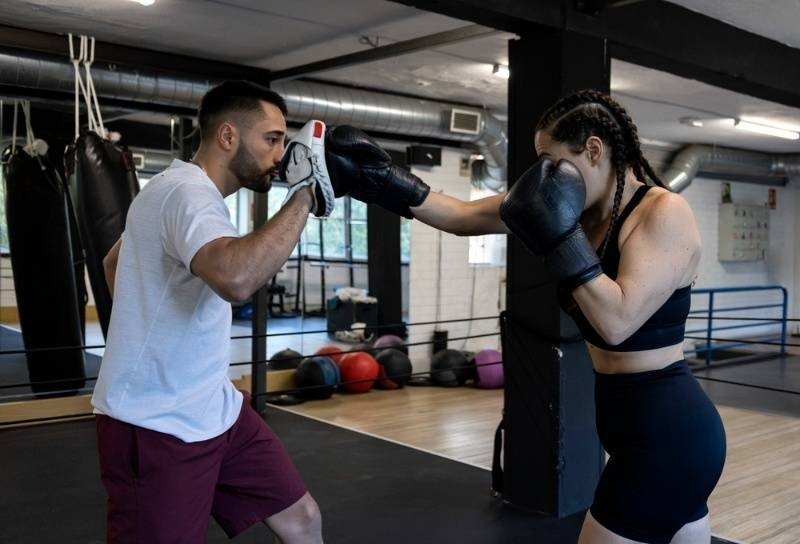
If the question is How do you start boxing as a complete beginner?, here is what you will generally encounter in your boxing training for beginners.
Warm-Up
- Jumping on a skipping rope.
- Mobility training.
- Stretching exercises.
This phase gets your body and brain ready for what’s about to happen. The coach might ask you to perform jumps, sprints, push-ups, and maybe some shadow boxing where you simulate punches into empty air.
Punching and Combo Practice
During the first few times, you will practice the punch in the air first, then with a partner (without gloves yet to learn control), and finally using a heavy bag or a mitt.
The coach will walk you through:
- Foot movements.
- Body weight transfer.
- Punch technique.
- Coordination and timing.
Your primary beginner boxing workout will consist of punches from boxing to simultaneously develop power, speed, dexterity, and balance.
Shadow Boxing
With the help of it, you can do boxing to punch at phantom opponents without the risk of them countering your moves.
Heavy Bag Work
You strike a large bag to work on power and combinations. These beginner boxing workouts typically consist of several rounds, often lasting between two and three minutes each. There is usually a short break between rounds, typically around thirty to sixty seconds.
Drills and Sparring
This is done with light contact with a partner. It is designed to help you practice your techniques on the fly, but without the big power shots.
Conclusion
Now, you have discovered why beginners love the game of boxing. If you’re trying to feel physically better and think more clearly with these beginner boxing tips, all whilst doing something challenging as hell but that is wildly enjoyable, maybe beginner boxing is just for you.
All you have to do is make that call and sign up for a class. What you'll discover when you enter the ring will make you so proud that you will have done it.
FAQs
How often should a beginner boxer train?
It's a good idea for a beginner boxer to train two to three times a week. This will give them plenty of practice in techniques but also provide enough time for their bodies to rest and recover in between training sessions. You need days to rest to ensure you are not put out with injuries, and the muscles can get stronger.
Do beginners have to spar?
It's not everyone who takes up boxing who takes it up with the intention to fight and spar. A number of people take up boxing for a whole other range of reasons, whether that may be for a form of fitness or just for the stress relief and general conditioning that comes with doing such a rewarding activity. They will typically first go through the various techniques, movements, and drills that have come from doing a session, and this will be followed by any sessions involving sparing.
Does boxing help with weight loss?
Boxing is a highly recommended exercise for weight loss. The training includes cardio conditioning as well as overall full-body movement. With a boxing session burning a high number of calories while at the same time developing the body's stamina and muscles, it has got to be a very efficient way of achieving your weight loss targets alongside healthy eating.
How long does it take to learn boxing basics?
The majority of those new to boxing will get accustomed to the basics within weeks after they have been regular in a course and, in turn, taking regular sessions. Learning the boxing basics has much more to do with repetition rather than anything to do with talent, and hard work will result in faster learning.